You’ve probably seen the glassy, well-lit faces flooding your feed and wondered if that kind of radiance is really reachable at home. Korean LED masks have moved from novelty gadget to a regular part of many routines, promising collagen support, calmer tone, and that lit-from-within finish without a clinic appointment. The trick is sorting the genuinely useful masks from the ones that overpromise. The nine picks below cover a real spread: full-face panels, neck-inclusive designs, dedicated eye treatments, and a clever serum-meets-device hybrid.
The IFAE Red Light Therapy Mask covers face and neck in one panel, which matters because most standalone masks leave the neck behind, and that’s exactly where crepey texture shows up first. The 396 LEDs run three wavelengths: 460nm blue (the kind often associated with blemish-prone skin), 660nm red, and 850nm near-infrared (NIR). NIR travels deeper than visible red, so it’s the wavelength people look for when they want support beneath the surface. For shoppers who’d rather not buy two separate devices, the dual-zone design saves drawer space.
Worth knowing: tri-wavelength panels tend to be more versatile than single-color masks, but you’ll still want to commit to regular sessions to see meaningful changes. For most routines, three to five times a week is realistic.
Positive Points
✓Face-and-neck coverage in one piece, no second device needed
✓Three wavelengths (blue, red, NIR) for varied skin goals
✓396 LEDs spread across both zones for even distribution
✓Suitable for users targeting both texture and tone in one routine
✓Dual-zone shape saves counter and charging-cable clutter
Things To Consider
•Heavier than face-only masks; longer sessions may feel warm around the neck
•Corded use during sessions limits where you can sit or lie down
Key Specs
Feature
Specification
Why It Matters
LED count
396 LEDs
Higher density usually means more even light delivery across both zones
Wavelengths
460nm blue, 660nm red, 850nm NIR
Three wavelengths cover surface and deeper skin layers in one session
Coverage zones
Face and neck
Treats the area most exposed to aging signs in a single panel
Who It Suits Best
Shoppers with early-to-moderate texture concerns who want a single device that handles both face and neck without buying two separate masks.
Skip It When
The AMIRO Red Light Therapy Eye Mask is the better call for anyone whose main concern lives around the eye area and not across the full face.
Compared to the IFAE’s tri-wavelength approach, this mask goes wide instead of deep, offering seven color modes that each target a different skin concern. For shoppers curious about LED therapy without committing to a higher-tier device, that variety is genuinely useful. The included eye shield matters: the source reminds you it must be worn during sessions, since direct LED exposure to the eyes is not advisable. Owners commonly treat sessions as quick, low-effort additions to an evening wind-down.
The build leans simple rather than premium, and the comfort depends a lot on face shape. For most users, ten to fifteen minutes is plenty for one color setting.
Good Reasons To Consider
✓Seven color modes let you experiment without buying separate masks
✓Includes protective eyewear for safer sessions
✓Lower entry cost than tri-wavelength panels like the IFAE
✓Painless, non-heat sessions suit sensitive skin
Worth Noting
•Plastic shell sits less flush on smaller or narrower faces
•Sessions are short-term fixes rather than deep-penetration therapy
•You must remember to wear the included eye shield every session
Made For
First-time shoppers who want to test LED therapy across multiple colors at a modest cost before investing in a more focused panel.
Look Elsewhere When
The INIA GLOW 4D Wireless Red Light Therapy Mask suits you better if you want near-infrared depth and a silicone fit that follows facial contours.
The INTEO mask is the one for shoppers who want coverage that runs all the way down to the chest. Unlike the IFAE’s face-and-neck panel, this one stretches further, and the wireless design frees you from being tethered to a wall outlet. With 680 total light beads across face, neck, and chest zones, density is the headline number. Four modes let you cycle through different wavelengths without fiddling with manual settings each time.
For most users with broader treatment zones, the wireless freedom is the standout perk, though larger coverage does mean longer session times to treat every area.
What Helps Most
✓Face, neck, and chest coverage in one device
✓680 light beads spread across three treatment zones
✓Wireless operation makes sessions location-flexible
✓Four preset modes simplify wavelength selection
Trade Offs
•Larger surface area means longer session durations than smaller masks
•Battery life limits how much area you can cover per charge
Key Specs
Feature
Specification
Why It Matters
Total light beads
680 across face, neck, chest
Higher bead count supports more even light distribution
Treatment zones
Face, neck, chest
Treats beyond just the face, useful for chest-area concerns
Operation
Wireless
Frees you from sitting near an outlet during sessions
Modes
4 preset modes
Easier than choosing wavelengths manually each session
Best Suited To
Shoppers who want to extend LED therapy beyond the face and care about neck and chest tone in a single cordless session.
Reach For A Different Pick When
The KYDJ 7-Color LED Face Mask with Remote is the better match if compactness and a hand-held controller matter more than coverage breadth.
The KYDJ leans into portability: a rechargeable battery and included remote mean you can settle into a session without getting up to tap a button. Where the KJNHhugH offers seven colors with a wired shell, this one trims the experience down to a simple, travel-friendly package. The 210 LEDs sit lower than the IFAE’s 396, so the coverage isn’t as dense, but the trade-off is a lighter, more packable build.
For most travelers and gift-givers, the portability is the bigger selling point than sheer LED count.
Features That Help
✓Rechargeable battery and remote control for hands-off sessions
✓Seven color modes for varied treatment goals
✓Compact build travels easily in a carry-on
✓Simple operation suits first-time users
Room For Improvement
•LED count is lower than higher-density masks like the IFAE
•Remote adds another small piece to keep track of during travel
Whose Shelf It Belongs On
Travelers and gift-givers who want a portable, easy-to-use LED mask that fits in a suitcase or overnight bag without hassle.
Swap It Out When
The AMIRO Light Facial Mask Spectra Silver fits better for shoppers who want ultra-short five-minute sessions on a tight weekday schedule.
The INIA GLOW 4D is the one to look at if silicone comfort and depth of treatment both matter. Where the IFAE uses a harder shell, this mask uses flexible medical-grade silicone that hugs the contours of the face. The “4D” framing refers to coverage across forehead, cheeks, chin, and jawline rather than an actual fourth dimension, useful context for shoppers scanning the listing. Dual near-infrared channels give the device two pathways for deeper light penetration, a configuration often found on higher-tier masks.
For most users who can stretch their budget, the silicone fit is what makes longer sessions tolerable.
Real-World Strengths
✓Flexible medical-grade silicone conforms to facial curves
✓320 LEDs distributed across four facial zones
✓Dual NIR channels for deeper-penetration treatment
✓Wireless design for unrestricted positioning during sessions
Honest Caveats
•Sits at a higher cost than entry-level masks
•Silicone interior requires gentle cleaning after each use
Key Specs
Feature
Specification
Why It Matters
LED count
320 LEDs
Solid density for full-face coverage
Material
Medical-grade silicone
Conforms comfortably to facial contours during longer sessions
NIR channels
Dual near-infrared
Two NIR pathways support deeper skin penetration
Operation
Wireless
Lets you sit or lie in a comfortable position
Right Fit For
Shoppers prioritizing a comfortable, contour-hugging fit and dual NIR depth over the lowest-possible cost.
Not Your Match When
The INTEO Wireless LED Face Mask 4 Modes is the better choice if extending treatment to the neck and chest is your main priority.
The BestQool mask earns its place through versatility: a touch screen replaces the buttons or dials you find on simpler masks, and the modular design suggests the brand intends you to use it on more than just the face. Six colors plus near-infrared give you a wider treatment palette than entry-level options without jumping to the higher-tier INIA. For shoppers who want one device they can use on face and other body areas, this is the practical middle of the lineup.
You may find the touch screen takes a beat to learn, especially mid-session when you can’t see it well.
What It Does Well
✓Touch screen interface is more intuitive than button-only masks
✓Six colors plus NIR cover most common skincare goals
✓Modular design supports use on face and other body areas
✓Sturdy shell tends to hold up well to regular use
Points To Note
•Touch screen controls can be tricky to read mid-session
•Modular parts add slightly more storage bulk than face-only masks
Perfect Match For
Shoppers who want a flexible face-and-body mask with a modern interface and don’t mind a slightly bigger footprint.
A Better Fit Elsewhere
The IFAE Red Light Therapy Mask for Face and Neck suits you better if face-and-neck coverage in a single panel matters more than body-area flexibility.
For shoppers who barely have time to brush their teeth, the AMIRO Spectra Silver is built around five-minute sessions. The three modes (Purify, Firm, and Glow) bundle the five wavelengths into preset routines rather than asking you to pick a color yourself. Where the KYDJ offers seven color choices and a remote, the AMIRO simplifies everything down to “pick a goal, press once, done.” That’s a real quality-of-life upgrade on hectic mornings or after long workdays.
For most busy weekday routines, five minutes per session is the difference between sticking with it and skipping it entirely.
Why It Works Well
✓Five-minute sessions fit realistically into packed mornings
✓Three preset modes remove guesswork for new users
✓Five wavelengths combined into a single synchronized system
✓Compact build stores easily in small bathrooms
A Few Limitations
•Five-minute sessions may feel short for users wanting deeper treatments
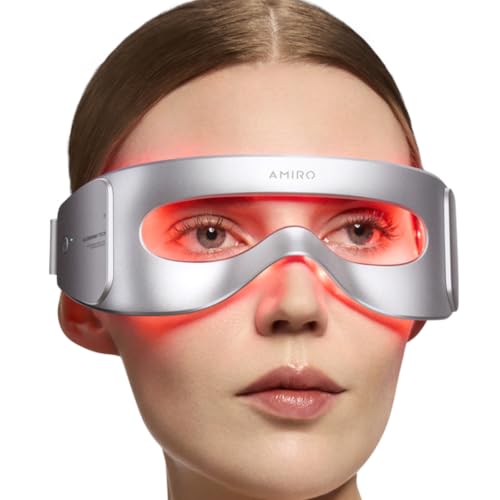
The AMIRO Eye Mask narrows the focus to where many full-face masks fall short: the under-eye area. Crow’s feet, fine lines, and tired-looking skin around the eyes tend to need targeted attention, and a full-face panel spreads light too thinly across that zone. This device uses four wavelengths (850nm infrared, 633nm red, 660nm deep red, and 605nm amber) with 96 LEDs, plus a medical-grade silicone shell that fits closely against the eye contours. Three minutes a day is the recommended session length, which is genuinely short.
For most shoppers focused on eye-area texture rather than full-face work, the dedicated design is more useful than a general mask.
Advantages To Know
✓Specialized eye-area focus targets fine lines and crow’s feet
✓Four wavelengths cover both surface and deeper layers around the eyes
✓Three-minute sessions fit into any routine
✓Silicone shell contours closely to the under-eye area
Things To Consider
•Treats only the eye area; pair with another device for full-face care
•Silicone fit varies depending on face shape and eye-socket depth
Who Will Love This
Shoppers whose main concern is under-eye fine lines, dark circles, or crow’s feet and who want a focused device rather than a general full-face mask.
Another Choice May Suit
The IFAE Red Light Therapy Mask for Face and Neck is the better pick if you want broader face-and-neck coverage in one device and don’t need specialized eye work.
The final pick on the list is the most unusual: a hybrid product that blends a PDRN-based eye cream with a built-in red light and microcurrent massager. PDRN (polydeoxyribonucleotide) is a skincare ingredient often discussed in K-beauty circles for its association with skin-renewal routines. The microcurrent element adds a gentle massage component that helps work the formula in, while the red light delivers light therapy simultaneously. For shoppers who want a low-commitment, daily-use option without strapping on a full mask, this lands in a different category than the rest of the list.
For most users who want light daily under-eye care more than a clinical-feeling session, this kind of hybrid can be easier to stick with than a mask.
The Upside
✓Combines skincare and device in one daily step
✓Built-in microcurrent massager helps work product into the under-eye area
✓PDRN-based formula aligned with K-beauty skincare trends
✓Compact enough for desk drawers and travel kits
Points To Keep In Mind
•Light therapy is less intense than dedicated masks like the AMIRO Eye Mask
•Cream component means ongoing product refills, not just device use
Built With In Mind
Shoppers who want a daily, low-effort under-eye treatment that blends skincare and light therapy without dedicating a full session to it.
Where Another Pick Suits Better
The AMIRO Red Light Therapy Eye Mask fits you better if you want a dedicated device with stronger, focused wavelengths rather than a hybrid cream-and-device approach.
Picking The Right Light Therapy Mask For Your Routine
Choosing a Korean LED mask comes down to a few honest questions about your skin, your schedule, and what kind of commitment feels realistic. The technology behind these devices is LED light therapy, which uses specific wavelengths of light (measured in nanometers, or “nm”) to reach different depths of the skin. Red light typically targets the surface and mid-layers, while near-infrared (NIR) penetrates deeper, where collagen and elastin production happen.
Match The Wavelengths To Your Skin Goals
If your main concern is surface texture or occasional blemishes, a red-light-only mask often does the job. For deeper concerns like firmness and elasticity, look for devices that include NIR wavelengths (around 850nm), which travel below the red light’s reach. Masks offering blue light (around 460nm) target the surface where breakouts tend to form. Multi-wavelength masks like the IFAE give you flexibility if your routine shifts over time.
Consider Coverage And Fit
Full-face masks work for general maintenance, but if your concerns live in specific zones (under-eyes, neck, chest), a dedicated device may serve you better. The AMIRO Eye Mask is the clearest example: it concentrates energy where a full-face mask spreads it thin. Silicone shells, like the one on the INIA GLOW, contour more closely to facial curves and tend to feel more comfortable during longer sessions.
Think About Realistic Session Length
A mask that asks for 30 minutes a session will sit unused on your shelf. The AMIRO Spectra Silver’s five-minute presets exist for a reason: short, repeatable sessions actually get repeated. For most shoppers, matching session length to your real schedule matters more than any spec sheet number.
Budget And Long-Term Value
Entry-level masks like the KJNHhugH offer a wide color palette at lower cost, while higher-tier devices like the INIA GLOW add comfort and depth. Worth weighing: a higher initial cost spread over years of use often works out cheaper than replacing a budget mask that doesn’t get used.
Smart Choices Across The LED Mask Category
Where Shoppers Go Wrong
Common slip-ups in this category usually come from chasing LED count or color variety instead of fit and consistency. A mask with 600 LEDs that sits awkwardly on your face for 20 uncomfortable minutes will collect dust, while a simpler mask you actually use three times a week delivers more. Another trap is buying a full-face mask when your concerns live entirely around the eyes or neck; targeted devices tend to deliver better results in those cases.
When Paying More Pays Off
Higher-tier models earn their cost through comfort (silicone vs. hard plastic), depth (single NIR vs. dual NIR), and session design (preset modes vs. manual settings). If you already know you’ll use the device three or more times a week, the upgrade tends to pay for itself in better experience. If you’re still testing whether LED therapy fits your routine, a budget option is the more honest starting point.
Frequently Asked Questions
How Often Should You Use a Korean LED Mask?
Most masks are designed for three to five sessions per week, with each session lasting anywhere from three to twenty minutes depending on the device. Following the manufacturer’s suggested schedule matters more than pushing for daily use, especially in the first two weeks while your skin adjusts.
Are LED Masks Safe for Sensitive Skin?
LED light therapy is generally well-tolerated, but the intensity and wavelength matter. Masks that include protective eyewear, like the AMIRO Eye Mask, reduce the risk of eye strain. Sensitive skin benefits from starting with shorter sessions and lower-intensity modes.
Do Wireless LED Masks Hold Enough Charge?
Wireless masks vary in battery life, so check the manufacturer’s listed session count per charge before buying. For most home routines, a full charge covers several sessions, which is enough for a typical week.
Can LED Masks Replace Your Regular Skincare?
LED therapy complements a skincare routine rather than replacing it. Cleansing, moisturizing, and sun protection still do the heavy lifting. LED masks add light-based support on top of that foundation.
How Long Before You Notice Results?
Visible changes typically appear after several weeks of consistent use, not overnight. Most shoppers who use their mask regularly report noticing differences in tone and texture within four to eight weeks.
Closing Remarks
The right Korean LED mask is the one that matches your routine, your skin goals, and your tolerance for setup. Start with where your concerns actually live: full-face, eye area, neck, or a low-commitment hybrid. From there, match wavelengths to depth and session length to your real schedule. Whatever you choose, consistency matters far more than LED count.