

A bright IPL flash calls for eyewear that matches the light source, the treatment room, and the length of your session. General safety glasses handle flying debris, while wavelength-specific laser goggles require a closer match to the equipment. The eight options below cover everything from bulk workplace protection to goggles designed for hair-removal lasers and other light-based treatments, with fit and optical-density details to guide your decision.
A Fast Comparison Of The Options

WFEANG Clear Safety Glasses 30 Pack
VOLTSPARK CO2 Laser Goggles OD 5+

WFEANG ANSI Z87.1 Safety Glasses

CARLANY CO2 Laser Goggles OD 5+

WFEANG Safety Glasses Over Eyeglasses
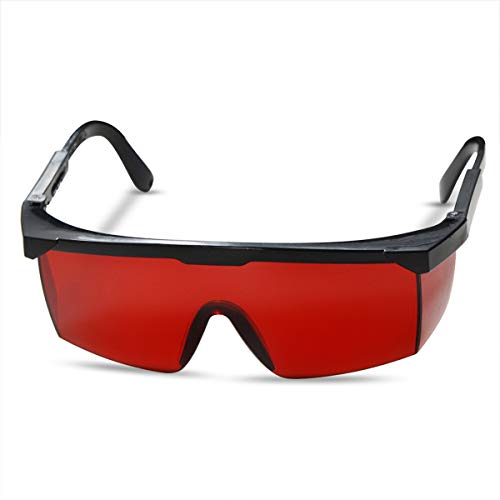
FreeMascot OD 4+ 190-550nm Laser Safety Glasses

3M Solus 1000 Gray Safety Glasses

FreeMascot OD 4+ 190-540nm Laser Safety Glasses
What Each Pick Brings To The Table
A wraparound clear lens gives you a practical field of view, while the flexible temples and curved tips help distribute pressure during a long shift. The 30-pair count is the standout detail: you can place a pair in a workshop, garage, classroom, or household drawer without rationing one pair among several people.
These glasses are designed for impact and flying-particle protection rather than wavelength-specific light filtering. That distinction matters in a treatment room because ordinary clear safety glasses do not automatically provide the optical filtering associated with laser or intense-light goggles. The listed ANSI Z87.1 designation makes this a more relevant general-purpose choice for construction, woodworking, painting, cycling, and yardwork.
Where It Helps
- The lightweight wraparound design supports extended wear without the bulk of a full goggle.
- Clear lenses preserve natural color perception, which helps with tool alignment and outdoor tasks.
- Thirty pairs suit teams, classrooms, workshops, and shared household storage.
- Polycarbonate construction targets resistance to debris and particles from several directions.
Trade Offs
- The clear lens is intended for impact protection, not a stated IPL wavelength range.
- Adult and teenager sizing may not suit smaller faces, so check the dimensions before ordering for children.
Key Specs
Who It Suits Best
You benefit most from this pack when you need impact protection for yardwork, DIY projects, sports, or shared workshop tasks rather than wavelength-specific light filtering.
A Better Fit Elsewhere
FreeMascot OD 4+ 190-550nm Laser Safety Glasses suit you better when your device operates within a stated treatment-laser wavelength range.
CO2 cutting and engraving equipment operates in a very different optical environment from a general workshop. This VOLTSPARK pair takes the specialized route with a 9,000- to 11,000-nanometer range and an optical density of 5+, making it the option to examine first when your equipment operates around a 10.6-micron CO2 laser.
Optical density describes how strongly a filter attenuates light at a specified wavelength, while wavelength defines the light the filter is intended to target. Those two figures need to agree with your actual machine. The honest read is that this is a purpose-built specialty goggle, not a general replacement for clear impact-protection glasses around a workbench.
Real-World Strengths
- The stated 9,000- to 11,000-nanometer range targets the central CO2 laser region.
- OD 5+ provides a clearly communicated attenuation specification for comparison.
- Goggle-style coverage suits operators focused on laser cutting and engraving equipment.
Practical Considerations
- Confirm that your laser output, beam type, and operating conditions fall within the manufacturer’s stated guidance.
- The CO2-focused range does not cover visible, violet, green, or broad-spectrum IPL light.
Technical Sheet
Built With In Mind
You need this focused design for a CO2 cutting or engraving setup whose specified wavelength falls inside the 9,000- to 11,000-nanometer range.
Another Choice May Suit
CARLANY CO2 Laser Goggles OD 5+ may suit you better when you need 10,600 nm called out explicitly alongside the broader CO2 range.
Having one pair of protective glasses in a drawer rarely solves a household or workplace shortage. This WFEANG bulk pack focuses on the practical advantage of distribution: you can keep protective eyewear in several work areas or make it available to a group without passing around a single pair.
The ANSI Z87.1 designation points toward impact-oriented safety eyewear, which makes it relevant to construction, industrial, laboratory, and general maintenance tasks. It does not identify a wavelength-specific filter, so you should not treat it as the same category of protection as the CO2 and treatment-laser goggles elsewhere in this list.
Standout Benefits
- Bulk packaging supports straightforward distribution across a team or multiple work areas.
- The ANSI Z87.1 designation gives you a recognized specification to compare with workplace requirements.
- General safety glasses offer a more practical format than sealed goggles for many short tasks.
Worth Noting
- The listing does not provide lens dimensions, so confirm fit before placing a large order.
- General safety eyewear does not replace wavelength-rated protection for intense treatment light.
Right Fit For
You gain the most from this bulk pack when managing impact protection for several people across workshops, labs, or other task-oriented environments.
Where A Sibling Pick Shines
WFEANG Clear Safety Glasses 30 Pack offer a more fully defined fit and quantity profile when you need stated dimensions and a large household distribution.
Many CO2 machines operate at 10,600 nanometers, also known as 10.6 microns. This CARLANY goggle lists both the wider 9,000- to 11,000-nanometer band and 10,600 nanometers, giving you a clear point of comparison with the label on your cutting or engraving equipment.
Compared with VOLTSPARK CO2 Laser Goggles OD 5+, the main difference is this explicit 10,600-nanometer callout rather than a clearly different optical-density figure. Both list OD 5+, so equipment compatibility should drive the decision more strongly than a general assumption that one goggle is automatically more protective.
Useful Strengths
- Explicitly lists 10,600 nm, a useful reference for common CO2 equipment.
- The broad 9,000- to 11,000-nanometer range accommodates nearby specified wavelengths.
- OD 5+ is stated prominently for straightforward technical comparison.
Points To Note
- Wavelength and optical density should be checked against the laser manufacturer’s eyewear guidance.
- Confirm side-shield and enclosure coverage for the specific cutting or engraving arrangement.
Quick Facts
Made For
You need this model for CO2 cutting or engraving work where the equipment is marked at 10,600 nm or otherwise falls within the stated range.
Reach For A Different Pick When
FreeMascot OD 4+ 190-550nm Laser Safety Glasses suit hair-removal or treatment equipment within their listed visible and near-infrared wavelengths.
Prescription frames create a familiar fitting problem: a separate pair of safety glasses may sit poorly, press against the temples, or become easy to lose during a task. This WFEANG model is designed to fit over eyeglasses, giving you a way to add outer protection without giving up your corrective lenses.
The bulk format and ANSI Z87.1 designation make it relevant for workplaces where several people wear prescription glasses. Its purpose remains general impact protection, though. You still need a wavelength-rated goggle for a treatment laser, and the over-glasses design adds another layer whose fit deserves a close check before extended use.
The Good Stuff
- The over-eyeglasses format addresses a concrete fit problem for corrective-lens wearers.
- Bulk packaging suits teams, classrooms, and shared work areas.
- The ANSI Z87.1 designation supports comparison with general workplace requirements.
Small Caveats
- Over-glasses styles add bulk, so check clearance around prescription frames and nearby equipment.
- No treatment-laser wavelength range is stated, limiting its relevance to IPL or laser applications.
Who Will Love This
You benefit most when you wear prescription eyeglasses and need general impact protection for a workshop, laboratory, or industrial task.
Swap It Out When
3M Solus 1000 Gray Safety Glasses suit you better when a gray lens and anti-fog coating matter more than layering over prescription frames.
Hair-removal devices and professional treatment lasers can operate at several visible and near-infrared wavelengths. This red FreeMascot goggle lists a 190- to 550-nanometer range, an OD 4+ specification, and common treatment wavelengths including 405, 445, 450, 520, and 532 nanometers, giving you several concrete points to compare with your equipment.
Compared with FreeMascot OD 4+ 190-540nm Laser Safety Glasses, this model extends the stated upper limit to 550 nanometers and explicitly names 445 nanometers. That difference may matter for a device with a longer wavelength, though neither title identifies a broad IPL band, so an IPL system needs its own documented compatibility check.
What Earns Its Place
- Covers a broad stated range extending from 190 through 550 nanometers.
- Names several wavelengths commonly encountered with hair-removal and treatment equipment.
- The red goggle format clearly separates it from ordinary clear safety glasses.
- OD 4+ supplies an attenuation rating for direct product comparison.
The Fine Print
- Confirm the exact output and pulse characteristics of your treatment device.
- Do not assume a wavelength range alone makes the goggle suitable for every IPL system.
At A Glance
Best Suited To
You need this model for a hair-removal or treatment laser whose documented output falls within the stated 190- to 550-nanometer range.
Not Your Match When
VOLTSPARK CO2 Laser Goggles OD 5+ suit you better for a 9,000- to 11,000-nanometer CO2 cutting or engraving laser.
Moving between a warm workshop and changing outdoor light can make clear lenses less comfortable, while fogging can interrupt a task at the worst moment. The 3M Solus 1000 uses a gray lens and Scotchgard anti-fog coating, a combination aimed at maintaining visibility during indoor and outdoor work.
The coating reduces the contact between microscopic water droplets and the lens surface, which helps limit the condensation that develops when moist air meets an uncoated lens. This is a general protective-eyewear feature rather than a treatment-laser wavelength specification, making it most useful for general job-site and workshop protection.
Positive Takeaways
- Scotchgard anti-fog coating addresses the familiar problem of condensation during active work.
- The gray lens is suited to indoor and outdoor environments with changing brightness.
- The Solus 1000 model name gives you a specific series to compare with other 3M options.
Possible Compromises
- A gray lens changes perceived brightness and color, which may not suit every detailed task.
- No wavelength range is stated, so it does not serve as a documented IPL filter.
The Right Fit
You gain the most from this model during general work where fogging and changing light conditions are more important than treatment-laser wavelength filtering.
Consider Something Else When
WFEANG Safety Glasses Over Eyeglasses fit you better when you need protection that accommodates prescription frames underneath.
A red laser goggle with a 190- to 540-nanometer stated range suits a different set of devices from the CO2 models, including treatment equipment that operates at common wavelengths near 405, 450, 520, and 532 nanometers. The OD 4+ figure gives you a second comparison point beyond the wavelength range.
Compared with FreeMascot OD 4+ 190-550nm Laser Safety Glasses, the distinction is a 10-nanometer lower upper limit and the absence of 445 nanometers from the named typical-wavelength list. For a 445-nanometer device, the 190-550nm model presents the more explicit match, while a device operating below 540 nanometers may make this version the clearer choice.
Good Reasons To Consider
- The stated 190- to 540-nanometer range covers several common treatment wavelengths.
- OD 4+ provides a defined attenuation specification.
- Red framing clearly distinguishes it from clear general-purpose safety glasses.
- The stated use cases include hair removal and laser treatment equipment.
Details To Watch
- Confirm the device wavelength before ordering, especially near the 540-nanometer upper boundary.
- Broad-spectrum IPL compatibility requires documentation beyond this stated range.
Feature Snapshot
Whose Shelf It Belongs On
You need this goggle for a treatment device operating at one of the listed wavelengths within the stated 190- to 540-nanometer range.
Look Elsewhere When
WFEANG Clear Safety Glasses 30 Pack suit you better for ordinary impact protection and broad household distribution rather than laser filtering.
Match The Light Before The Frame
Identify The Actual Light Source
Your eyewear decision begins with the equipment, not the frame. A CO2 cutter usually presents a very different wavelength profile from a visible or near-infrared treatment laser, and an IPL device may produce a broad band rather than one fixed wavelength. Check the manufacturer’s output information and its recommended protective-eyewear specifications before choosing.
General safety glasses belong in the impact-protection category. Wavelength-rated goggles belong in the optical-filtering category, where the stated range must overlap the light produced by your device. Never substitute one category for the other simply because both products cover the eyes.
Read Optical Density Correctly
Optical density, abbreviated OD, describes how strongly a filter attenuates light. A higher figure indicates greater attenuation within the filter’s specified wavelength range, but it does not make an otherwise mismatched filter suitable. Pair the OD figure with the wavelength range and follow the guidance supplied with your laser or IPL equipment.
Check Comfort And Layering
A protective goggle that shifts, pinches, or leaves gaps may be impractical during a long session. For prescription glasses, an over-eyeglasses design may be easier than forcing frames beneath a sealed goggle. You also need enough room around the brow, cheeks, and temples without compromising the stated coverage.
Match The Task
You need general impact protection for sawdust, paint, construction debris, and yardwork. You need optical filtering for an IPL device or treatment laser, with the exact source and pulse characteristics accounted for. A bulk pack makes sense for a workshop or team, while a specialized goggle makes more sense beside one carefully defined machine.
Two Mistakes That Can Distort Your Choice
Common Shopping Slip Ups
The most consequential mistake is treating “safety glasses” as one interchangeable category. Another is selecting by appearance or by a single wavelength number without checking the device’s full output range. Avoid mixing general impact glasses, CO2 goggles, and treatment-laser filters in the same comparison, because they serve different purposes.
What Separates Premium From Basic
A more specialized goggle may provide a narrower wavelength target, a stated optical density, a fuller enclosure, or a coating designed for fog control. Those upgrades help only when their specifications match your equipment and work environment. Spending more on general impact glasses adds little protection when the real need is wavelength-rated eye protection.
Final Verdict
Start with the light source, then narrow the field by optical density, coverage, and comfort. The WFEANG packs serve general impact-protection needs, the 3M Solus 1000 emphasizes fog control, and the laser-specific goggles suit carefully defined wavelength ranges. Match the product to the task and you can choose with far more confidence.
